
Transfer Pricing in UAE
The implementation of corporate tax in the UAE has introduced transfer pricing, based on OECD principles, as a critical compliance requirement for businesses. Transfer pricing ensures that transactions between related or connected parties are priced fairly, safeguarding the integrity of the tax base. At HLB HAMT Management Consultancy (HHMC), we simplify the complexities of transfer pricing, offering practical services to help businesses comply with regulations and optimise their international operations. Our expert team provides tailored solutions to navigate evolving policies, allowing you to focus on growth and ensuring adherence to the transfer pricing rules in the UAE.
What is Transfer Pricing in UAE and UAE?
Transfer pricing refers to the rules on setting of arm’s length prices for Controlled Transactions, including but not limited to the provision or receipt of goods, services, loans and intangibles. It ensures that these transactions are conducted fairly, and according to market standards, in line with OECD principles. The transfer price should be at an ‘open market’ or ‘arm’s length’ value, which prevents companies from manipulating intragroup prices to reduce their overall tax bill. This practice helps prevent profit shifting and maintains the integrity of the tax base, especially as regulations evolve in regions like the UAE.
Transfer Pricing Services for Foreign companies operating in UAE
Based on the new Transfer Pricing Guide of the Federal Tax Authority, all foreign companies operating in UAE are required to align their transfer pricing with the new regulations, and must conduct transactions as an independent organisation. As a reliable partner and trustworthy organisation, we have updated our Transfer Pricing services to the latest standards, following the new guidelines and ensuring compliance. As we overlook all transactions of our partners rather than limiting our services inside the country, we are able to manage your transfer pricing concerns efficiently, while you can focus on your core activities without being concerned about potential penalties or legal actions.
Applicability of Transfer Pricing in the UAE
Transfer pricing rules apply to all transactions between related parties and connected persons, which include
- Cross-Border and Domestic Transactions: The rules encompass both cross-border transactions and domestic dealings, including those with free zone entities.
- Government Transactions: Transactions between mandated and non-mandated segments of government entities are also subject to these regulations.
- Exempt Entities: Businesses classified as exempt or that have chosen small business relief must comply with arm’s length standards for inter-company transactions. But exempt entities are not obligated to prepare or maintain local and master files.
Schedule a Consultation
Who Are Related Parties and Connected Persons Under the UAE Corporate Tax Regime?
Under the UAE corporate tax regime, related parties are defined as any Person associated with a Taxable Person as determined in Article 35(1) of the Corporate Tax Law. This association means pre-existing relationship with another Person through kinship (in case of natural persons), ownership or Control, regardless of whether that other Person is resident or not in the UAE.
The following criteria help identify related parties:
- Kinship or Affiliation: Covers relationships up to the fourth degree of kinship, including by adoption or guardianship.
- Ownership: A natural person and a juridical person are related if the individual, or related parties of the individual, directly or indirectly own 50% or more of the juridical person.
- Control: A person is considered related if they have direct or indirect control over another person (e.g., through voting rights, board composition, profit distribution, or influence over business affairs).
Kinship or Affiliation
The definition of kinship or affiliation covers the relationship of two or more individuals who are related up to the fourth degree of kinship or affiliation, including by way of adoption of guardianship. In the context of the UAE, kinship includes common blood ties as determined by the ancestors or common ancestors of the individual, where an ancestor or common ancestor may include guardians or adoptive parents, and affiliation covers relationship by marriage, or if one natural person’s spouse is related by kinship to the other Natural Person.
Ownership
A Natural Person and a juridical person are Related Parties by way of ownership where the individual, or one or more Related Parties of the individual, are shareholders in the juridical person, and the individual, alone or together with its Related Parties, directly or indirectly owns a 50% or greater ownership interest in the juridical person.
Control
Control is the direction and influence over one Person by another Person and can be determined in several ways including but not limited to instances where:
- a Person can exercise 50% or more of the voting rights of another Person;
- a Person can determine the composition of 50% or more of the board of directors of another Person;
- a Person can receive 50% or more of the profits of another Person; or
- a Person can determine, or exercise significant influence over, the conduct of the Business and affairs of another Person.
“Related party” also means any of the following ties:
- Person and its Permanent Establishment (“PE”) or Foreign PE,10 meaning that
- Transfer Pricing rules apply to transactions between a Person and their PE or Foreign PE;
- two or more Persons that are partners in the same Unincorporated Partnership; and
- a Person who is the trustee, founder, settlor or beneficiary of a trust or foundation and the trust or foundation, including the trust’s or foundation’s Related Parties.
Exemption applies to non-exempt business activities conducted by the same person.
Connected persons are treated separately from related parties in the UAE corporate tax framework. Where a Person is considered to be a Connected Person of a Taxable Person, all payments or benefits provided by the Taxable Person to the Connected Person are deductible for Corporate Tax purposes only to the extent that they correspond to the Arm’s Length Price of the service or benefit provided and they are incurred wholly and exclusively for the purposes of the Taxable Person’s Business.
A Person is considered a Connected Person of a Taxable Person if that Person is
- An Individual who has an ownership interest in, or control over, a taxable person, directly or indirectly.
- Directors or officers of the taxable person, or
- Individuals related to the owner, director, or officer of the taxable person up to the fourth degree of kinship, including relationships arising from birth, marriage, adoption, or guardianship.
- In an unincorporated partnership, other partners in the same partnership are also considered connected.
- Any related party of the aforementioned individuals.
Controlled Transactions
A “Controlled Transaction” is a transaction or arrangement between Related Parties or Connected Persons. Controlled Transactions generally include the supply or transfer of tangible goods, provision and receipt of services, funding and other financial transactions, and commercial exploitation of intangible assets such as patents, brands and know-how.
For the purposes of the UAE Transfer Pricing rules, all cross border Controlled Transactions (i.e. transactions between the Person and its Related Parties or Connected Persons that are located in different tax jurisdictions) as well as domestic Controlled Transactions (i.e. transactions between Related Parties or Connected Persons located in the UAE, including transactions undertaken between Free Zone Persons) must follow the Arm’s Length Principle.
The Arm’s Length Principle (ALP), adopted in the UAE under Article 34 of the Corporate Tax Law, mandates that pricing for transactions between related parties or connected persons should reflect the prices set between independent entities under similar circumstances.
This principle ensures fair profit allocation and compliance with transfer pricing rules, vital for both domestic and cross-border transactions. Companies must apply one of several internationally recognised methodologies for determining arm’s length prices, as outlined by the OECD Transfer Pricing Guidelines. If standard methods prove impractical, alternative approaches may be justified.
Arm’s Length Price: The price established for a particular business transaction based on the Arm’s Length Principle.
Arm’s Length Principle in the UAE
Application of the Arm’s Length Principle
Step 1: Identify Related Parties, Connected Persons, relevant transactions and arrangements and perform a comparability analysis accordingly.
Step 2: Selection of the most appropriate Transfer Pricing method.
Step 3: Determination of the Arm’s Length Price
Transfer Pricing Methods in UAE
Determining a fair price for transactions between related companies can be done using different transfer pricing methods. The OECD outlines several methods to choose from:
Traditional Transaction Methods
- Comparable Uncontrolled Price (CUP) Method: Looks at the price charged in similar transactions between unrelated parties. Where the CUP method is applied, the Controlled Transaction may be compared to an internal or an external Comparable Uncontrolled Transaction, depending on the circumstances:
- Internal CUP: The price of a similar transaction between related parties and a third party.
- External CUP: The price of a similar transaction between two or more third parties.
- Resale Price Method: Based on the price at which a product, that has been purchased from a Related Party, is resold to an independent party.
- Cost Plus Method(CPM): considers the direct and indirect costs incurred by a supplier in supplying goods or services in a Controlled Transaction and applies an appropriate mark-up to these costs based on the functions performed by the supplier and the profit that would have been earned from an arm’s length transaction depending on the market conditions.
- Internal comparable: where the cost-plus mark-up of the supplier in the Controlled Transaction is determined by reference to the cost-plus mark-up that the same supplier earns in a similar transaction with an independent party; or
- External comparable: where the cost-plus mark-up of the supplier in the Controlled Transaction is determined by reference to the cost-plus mark-up that would have been earned in comparable transactions between two independent parties.
Transactional Profit Methods
- Transactional Profit Split Method: Seeks to determine the division of profits that independent parties would have expected to realise from engaging in comparable transactions.
- Transactional Net Margin Method: Compares the net profit margin of a controlled transaction to similar uncontrolled transactions.
Choosing the right method involves considering factors like the availability of data, the strengths and weaknesses of each method, and how well each method fits the nature of your transactions. Once you select the best method and find reliable comparisons, you can calculate a fair price range.
In some cases, you may use methods other than those approved by the OECD, as long as you can show that your chosen method provides a reliable measure of an arm’s length price and meets the requirements of UAE corporate tax law.

Functional Analysis
Risk management: This refers to the function of assessing and responding to risk associated with a commercial activity.
Financial capacity to assume risk: This can be defined as having the capital or funding to take on the risk or to lay off the risk, to pay for the risk mitigation functions and to bear the consequences of the risk if it materializes.
Control over risk: This involves the first two elements of risk management, that is (i) the capability to make decisions to take on, lay off, or decline a risk-bearing opportunity, together with the actual performance of that decision-making function, and (ii) the capability to make decisions on whether and how to respond to the risks associated with the opportunity, together with the actual performance of that decision-making function.
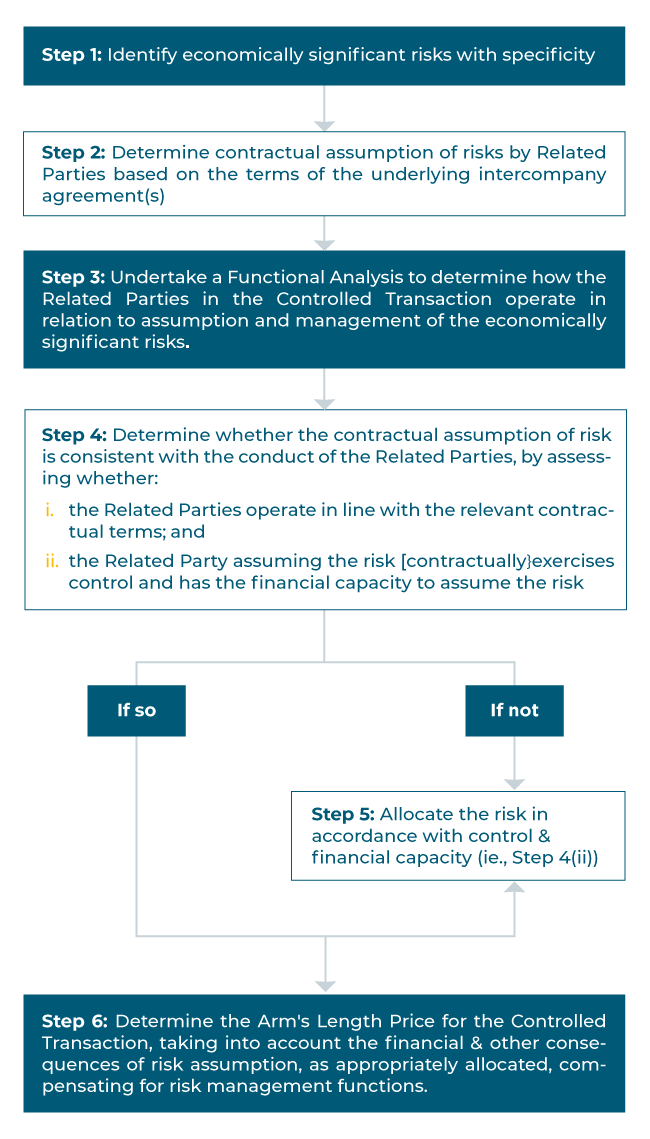
In transactions between two independent parties, compensation usually reflects the functions that each enterprise performs, the assets it uses, and the risks it assumes. The same principle needs to be applied to transactions between Related Parties or Connected Persons. As such, a comprehensive Functional Analysis of the Controlled Transaction is required as part of a comparability analysis to delineate the transaction and determine comparability between the Controlled Transaction and uncontrolled transactions.
There is a six-step process for analysing the risks in a Controlled Transaction, in order to accurately delineate the actual transaction in respect to those risks. This process is summarised as follows:
Before detailing this six-step process, the following terms need to be defined and understood:
The End-to-End Transfer Pricing Services from HLB HAMT Management Consultancy (HHMC)
A transfer pricing assessment functions as a transaction identifier, evaluating each transaction to ensure compliance with the arm's length principle. This important step helps businesses maintain transparency and integrity in their financial operations while implementing effective tax compliance according to international standards. Additionally, it allows companies in the UAE to address issues proactively and refine their pricing strategies, reducing the likelihood of disputes with tax authorities in the future.
A transfer pricing impact assessment helps businesses understand how new transfer pricing rules will affect their finances and operations. Here's how we approach it:
- Identifying Related Party Transactions: We look at important transactions between related companies and outline what’s needed for compliance with UAE transfer pricing regulations.
- Evaluating Effects: We assess both the financial and operational impacts of the new rules to help your business prepare for any changes.
- Finding Risks and Opportunities: Our team helps identify what adjustments are necessary to create a stronger, more efficient transfer pricing model that meets regulations and takes advantage of potential growth.
Transfer Pricing disclosure form which covers details of the Controlled Transactions during a Tax Period. Under Article 55(1) of the Corporate Tax Law, all taxable persons that engage in transactions with related parties or connected persons and are above a materiality threshold, must submit a transfer pricing (TP) disclosure form along with their corporate tax return, as mandated by the Federal Tax Authority (FTA) for compliance.
- Mandatory Reporting: If aggregate related-party transactions exceed AED 40 million, or if the aggregate value per category exceeds AED 4 million, these must be reported.
- Connected Person Disclosure: Transactions exceeding AED 500,000 per connected person must be disclosed.
Included as part of the corporate tax return, the form summarizes controlled transactions during the financial year.
In the UAE, companies that are part of a multinational enterprise (MNE) group with consolidated revenues exceeding AED 3,150,000,000, or those with individual revenues above AED 200,000,000, are required to prepare both a Local File and a Master File.
- Local file
A local file is a type of transfer pricing documentation that provides detailed information about specific controlled transactions occurring during the relevant tax period. It includes data on intercompany transactions, the identities of related parties, applicable transfer pricing methods, and a comprehensive analysis demonstrating compliance with the arm’s length principle. This file is crucial for maintaining transparency and must be provided to the UAE tax authorities upon request.
- Master file
Master File offers an overview of the entire MNE group's global operations, including policies and procedures related to transfer pricing. This document encompasses high-level information about the business structure, key value drivers, and the allocation of income and economic activity. Together, these files ensure compliance with regulations and facilitate effective monitoring of transfer pricing practices across jurisdictions.
Country by Country Report: Global allocation of the MNE groups’ income and tax paid, indicators of the location of economic activity within the MNE group.
Additional supporting information upon request of the FTA, pursuant to Article 55(4) of the Corporate Tax Law.
Benchmarking in transfer pricing involves comparing the pricing of a company's intercompany transactions with similar transactions between independent entities under comparable conditions.
The key purpose of a benchmarking study in transfer pricing is to determine the general conditions related to the transactions performed by third parties on a given market. Conducting a benchmarking study helps you elicit a range of values such as the arm’s length range or mark-up range.
This process helps determine if a company’s transfer prices adhere to the arm's length principle, ensuring fair pricing practices.
At HLB HAMT Management Consultancy (HHMC), we leverage globally recognized benchmarking software to deliver accurate and comprehensive benchmarking services. Our advanced tools enable the collection and analysis of extensive data on comparable transactions, allowing us to assess and validate the appropriateness of your pricing strategies effectively.
UAE Transfer Pricing Documentation Requirements
Why Choose HLB HAMT Management Consultancy (HHMC) for Your Transfer Pricing Services in Dubai?
At HLB HAMT Management Consultancy (HHMC), we have a passionate team of transfer pricing specialists dedicated to simplifying the complexities of transfer pricing regulations. We’re here to support you every step of the way.
Our focus-based approach means we take the time to understand your unique challenges. We tailor our solutions to fit your business while ensuring compliance with local and international standards.
HLB HAMT Management Consultancy (HHMC) offers a full range of end-to-end transfer pricing services. From documentation to ongoing compliance support, we’re committed to helping you succeed.
We use globally recognised benchmarking software to provide you with the most accurate and relevant data for your transfer pricing benchmarking.
We follow a clear and structured process for transfer pricing to make sure all your needs are addressed. Our well-planned approach keeps everything organised, so you can have peace of mind knowing we’ve got it covered.
With over 25 years in the industry, we’ve built a strong reputation for delivering effective transfer pricing solutions. Our extensive experience allows us to help you achieve both compliance and a strategic edge.
Pillar Two Impact Analysis
At HLB HAMT Management Consultancy (HHMC), we are committed to guiding businesses through the complexities of the Domestic Minimum Top-Up Tax (DMTT) and Pillar Two compliance. Starting January 2025, these changes will require Multinational Enterprises (MNEs) with global revenues of €750 million or more to ensure a minimum effective tax rate of 15% on UAE profits. Here’s how we can help
01
Readiness Assessment:
Analyze your eligibility, effective tax rates, and compliance status under Pillar Two.
02
Strategic Tax Planning
Optimize your tax structures and align Transfer Pricing policies with global standards.
03
Compliance Support
Prepare and update Transfer Pricing documentation and ensure readiness for Federal Tax Authority (FTA) reviews.
04
GloBE Solutions
Leverage advanced tools for accurate Global Anti-Base Erosion (GloBE) compliance and reporting.
05
Advocacy
Represent your business in discussions with the FTA and assist in securing Advance Pricing Agreements (APAs).
06
Ongoing Support
Provide updates, training, and tailored advice to adapt to policy changes.
Frequently Asked Questions
Transfer pricing refers to the rules on setting of arm’s length prices for Controlled Transactions, including but not limited to the provision or receipt of goods, services, loans and intangibles. It ensures that these transactions are conducted fairly and according to market standards, in line with OECD principles.
Transfer pricing rules apply to transactions between related parties and connected persons, including cross-border and domestic transactions, government transactions, and exempt entities.
A “Controlled Transaction” is a transaction or arrangement between Related Parties or Connected Persons. Controlled Transactions generally include the supply or transfer of tangible goods, provision and receipt of services, funding and other financial transactions, and commercial exploitation of intangible assets such as patents, brands and know-how.
The Arm’s Length Principle (ALP), adopted in the UAE under Article 34 of the Corporate Tax Law, mandates that pricing for transactions between related parties or connected persons should reflect the prices set between independent entities under similar circumstances.
This principle ensures fair profit allocation and compliance with transfer pricing rules, vital for both domestic and cross-border transactions.
- Comparable Uncontrolled Price (CUP) Method
- Resale Price Method
- Cost Plus Method (CPM)
- Transactional Profit Split Method
- Transactional Net Margin Method
- Other
Transfer pricing documentation is a crucial set of records that multinational companies create to support their transfer pricing strategies. This documentation is vital for complying with tax regulations and proving that intercompany pricing aligns with the arm’s length principle.
Key requirements include the Transfer Pricing Disclosure Form (TPDF), Master File (MF), Local File (LF), Country-by-Country Report (CbCR), and any additional information that the FTA may request during the tax period.
An Agreement (APA) is a formal agreement between a taxpayer and a tax authority that outlines the transfer pricing methodology for the taxpayer’s transactions for future years. This methodology is applied over a specified period based on the fulfilment of certain terms and conditions.
Transfer pricing litigation involves disputes between companies and tax authorities over the pricing of intercompany transactions. These disputes arise when authorities believe that the pricing doesn't follow the arm's length principle. The process can include negotiations, appeals, or even legal proceedings, where both sides present their arguments to ensure compliance with transfer pricing regulations.
Transfer Pricing Due Diligence (TPDD) is an essential process that assists multinational enterprises (MNEs) in recognising and addressing transfer pricing risks linked to the target company.
With the recent introduction of corporate tax in the UAE, the country’s previously business-friendly, tax-friendly environment is evolving. Transfer pricing regulations have now become mandatory, making it essential for businesses to adhere to these rules. Compliance with transfer pricing standards is critical for related parties and connected persons to ensure proper pricing of intercompany transactions and avoid potential tax disputes.
Featured insights
Latest insights, case studies and news from
across the network

KEZAD Metal Park UAE: World’s First Pay-As-You-Grow Industrial Ecosystem and What It Means for Businesses
HLB HAMT Management Consultancy (HHMC) Team UAE continues to strengthen its position as a global...

UAE E-Invoicing Explained: Expert Answers on Deadlines, Scope, and Business Readiness
HLB HAMT Management Consultancy (HHMC) Team As the UAE moves toward mandatory e-invoicing from 2026,...

How Outsourcing Accounting Services in the UAE Helps Businesses Cut Costs by Up to 40%
HLB HAMT Management Consultancy (HHMC) Team In an increasingly regulated and competitive business environment, cost...

End-to-End Accounting Cycle for UAE Businesses: Key Considerations for Effective Financial Management
HLB HAMT Management Consultancy (HHMC) Team The accounting cycle is fundamental to business operations in...