
Corporate Tax and Transfer Pricing in UAE
HLB HAMT Management Consultancy (HHMC) Team

How do you perceive Corporate Tax? An opportunity for growth? Or simply another layer of compliance for companies? As the UAE implements its Corporate Tax framework, businesses must navigate various complexities and challenges that come with it. In recent discussions during our event, we explored critical topics such as the intensity of challenges associated with Corporate Tax, the registration process, compliance requirements, and strategies for effective management.
Understanding these elements is crucial for businesses to adapt to the evolving tax landscape and leverage potential growth opportunities while ensuring compliance with the new regulations.
Corporate tax
Corporate Tax (CT) is a direct tax based on the net income or profit of businesses. It is also known as “Corporate Income Tax” or “Business Profits Tax” in other countries.
With the introduction of corporate tax in the UAE, businesses in UAE need to understand their tax responsibilities and stay compliant. Starting June 1, 2023, the UAE has applied a corporate tax on business profits. The tax rate is 0% for taxable income up to AED 375,000, and 9% on any income over that amount. This makes it important for businesses to comply with tax rules to avoid legal issues and keep their finances strong.
Understanding the roles of Accountants and Tax Consultants
- Distinct Roles: Accountants focus on financial reporting, while tax consultants specialize in tax compliance and strategy.
- Revenue Recognition: Under IFRS 15, revenue is recognized when control of goods/services is transferred, which may differ from VAT supply dates.
- Withholding Tax: Accountants may treat withholding taxes in foreign jurisdictions as expenses; for Corporate Tax, they are non-deductible and claimed as Foreign Tax Credits on the Balance Sheet.
- Expense Categorization: Accountants may classify hotel expenses as “Marketing Expenses,” but tax consultants view them as Entertainment Expenses, subject to a 50% cap for Corporate Tax
Corporate Tax Registration in UAE
- Different taxable persons for VAT and Corporate Tax (CT): Understanding the different categories of taxable persons for VAT and corporate tax.
- Legal type changes: Considering any changes in the legal structure of the business.
- Difference in License issue date and incorporation/establishment date: Examining the discrepancies between the license issue date and the incorporation or establishment date.
- Determining whether the taxable person is a Resident or Non-Resident: Identifying the residency status of the business for tax purposes.
Facts to Clarify: Key Factors for Corporate Tax Registration in the UAE
Here are some important factors to consider for corporate tax registration for a natural person in the UAE:
- Combining Financials: If a person owns multiple sole establishments, they need to combine their revenues to see if they meet the overall income threshold.
- Revenue Threshold: Check if the total revenue from all sources is more than AED 1 million, which is the requirement for corporate tax registration.
- Determining Income Sources: Identify where the income comes from, such as real estate investments, personal investments, or wages.
- Licensing Requirements: Verify whether any licenses are needed for personal or real estate investments with the appropriate authority.
- Single Registration: A natural person only needs one registration for corporate tax, even if they have multiple income sources.
- Non-Deductible Expenses: Any salary, withdrawals, or payments made to the natural person from their business are considered non-deductible expenses for corporate tax purposes.
Permanent Establishment (PE) for Corporate Tax
Here are factors relating to Permanent Establishment for corporate tax purposes in the UAE:
- PE Outside UAE: Assess whether the business has a fixed place of business or dependent agent outside the UAE.
- PE in UAE for Foreign Persons: Determine if foreign entities or individuals have a Permanent Establishment in the UAE.
- Identifying PE: Check if the business activities in the UAE qualify as a Permanent Establishment.
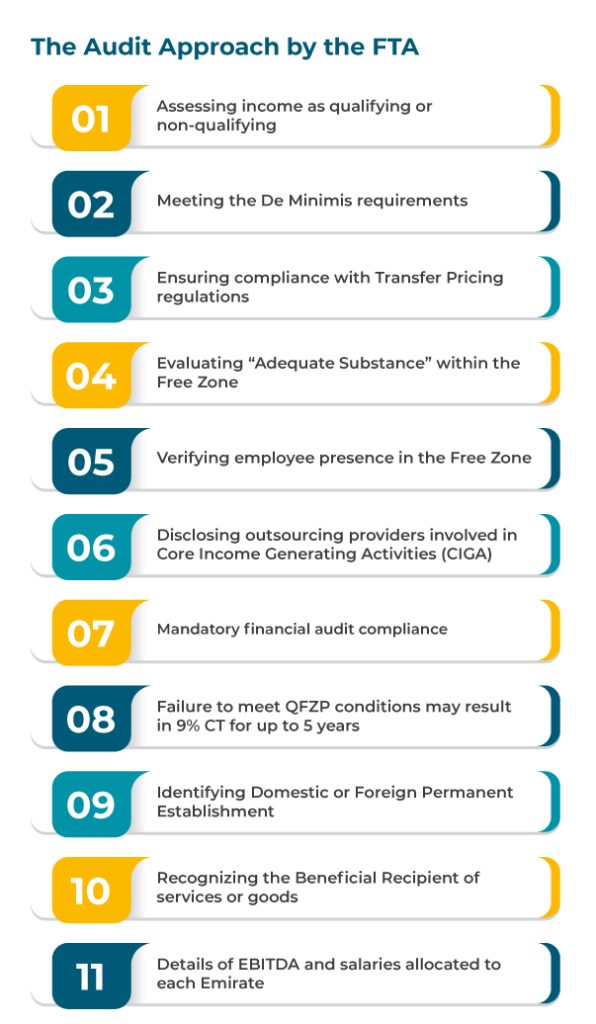
Key Considerations for Accounting and Auditing in Corporate Tax Compliance
Accounting
- Recording Personal Investments: Accurately record owners’ personal investments in company books.
- Reconfiguring Chart of Accounts: Adjust the chart of accounts to align with tax regulations, identifying qualifying, non-deductible, and capitalized expenses.
- Assessing Deferred Tax Assets/Liabilities: Evaluate the impact of deferred tax assets and liabilities on the company’s tax obligations.
- Provisioning for CT Payable: Ensure adequate provisions are made for corporate tax liabilities.
Auditing
- Mandatory Audit Compliance: Meet all required audit standards for the company.
- Recognizing Financial Statement Items: Identify realized or unrealized items in financial statements that won’t be recognized in the income statement.
- Allocating Shared Resources: Properly allocate shared resources and finance costs for interest deductions.
- Identifying Exempt Income: Recognize any income exempt from taxation.
- Accurate Expense Ledger Entries: Ensure credit entries are correctly recorded in the expense ledgers.
Documents to Be Uploaded
- Financial Statements
- Master File and Local File
- Market Value Documentation for Qualifying Immovable Property
- Ownership Confirmation for Qualifying Intellectual Property
- Market Value Documentation for Financial Assets/Liabilities
Thresholds for Financial Reporting and Taxation in the UAE
Here’s a breakdown of important thresholds that businesses in the UAE should be aware of regarding financial reporting and taxation:
- Audit Requirements:
- Businesses with a turnover of AED 50 million or those registered in the Qualifying Free Zone (QFZP) must undergo mandatory audits.
- Small Business Relief:
- Companies with revenue below AED 3 million may qualify for specific tax reliefs or exemptions.
- Net Interest Expenditure:
- For tax purposes, the net interest expenditure is determined as the higher of AED 12 million or 30% of EBITDA (Earnings Before Interest, Taxes, Depreciation, and Amortization).
- Accounting Basis:
- Cash and Accrual Accounting: Businesses can choose between cash or accrual methods based on revenue.
- Accrual Method: Required for businesses with revenue exceeding AED 3 million.
- Cash Method: Can be used by businesses with revenue below AED 3 million.
- IFRS Standards:
- IFRS Compliance: Required for businesses with revenue over AED 50 million.
- IFRS for SMEs: Businesses with revenue below AED 50 million may use simplified standards.
- Natural Person Income:
- Individuals must have an income of AED 1 million or more to be subject to corporate tax.
- Preparation of Local File and Master File:
- Businesses with revenue of AED 200 million or more must prepare these files for transfer pricing documentation. MNEs with consolidated group revenue of AED 3.15 billion or more also need to prepare these files.
- Top-Up Tax:
- Multinational Enterprises with consolidated group revenue of AED 3.15 billion or more are subject to a 15% top-up tax.
Understanding Transfer Pricing Requirements
Effective transfer pricing involves several critical considerations:
- Identifying Unaccounted Transactions: Ensure all related party transactions are properly accounted for.
- Selecting the Right Method: Choose the most suitable transfer pricing method for different transactions.
- Understanding Limitations: Be aware of the limitations of using internal comparables and the risks associated with transfer pricing software.
- Connected Persons: Determine any related parties involved in transactions.
- Market Value Challenges: Recognize complexities in valuing salaries and benefits for related parties.
- Documentation Requirements: Prepare Master and Local Files based on the size and nature of transactions, as there is no specific revenue threshold in the UAE.
HLB HAMT Management Consultancy (HHMC) to assist!
At HLB HAMT Management Consultancy (HHMC), we are professionals dedicated to helping your business navigate the complexities of corporate tax compliance. Let us assist you in analyzing the impact of Corporate Tax on your company with our comprehensive services. Contact us today to ensure that you are fully equipped to tackle the challenges and seize the opportunities that come with Corporate Tax regulations!
Get in touch today: Call us or Email us. Your success is our priority!